Adam from an Ape-Man?
by Creation Museum on July 2, 2026Did God create Adam out of an ape-man? When we use God’s Word as our starting point, we know that’s simply not true!
God created the land animals, including the apes, on the sixth day. Then he made man in his image from the dust of the ground—not from an ape-like ancestor.
Then God said, “Let us make man in our image, after our likeness. And let them have dominion over the fish of the sea and over the birds of the heavens and over the livestock and over all the earth and over every creeping thing that creeps on the earth.” (Genesis 1:26)
Then the Lord God formed the man of dust from the ground and breathed into his nostrils the breath of life, and the man became a living creature. (Genesis 2:7)
Lucy
Discovered in the Awash Valley of Ethiopia in 1974 and conventionally dated at 3.2 million years, “Lucy” is the fourth-known, most complete, and most famous specimen of Australopithecus afarensis. Despite usually being depicted as very humanlike, Lucy’s species is classified as non-human.
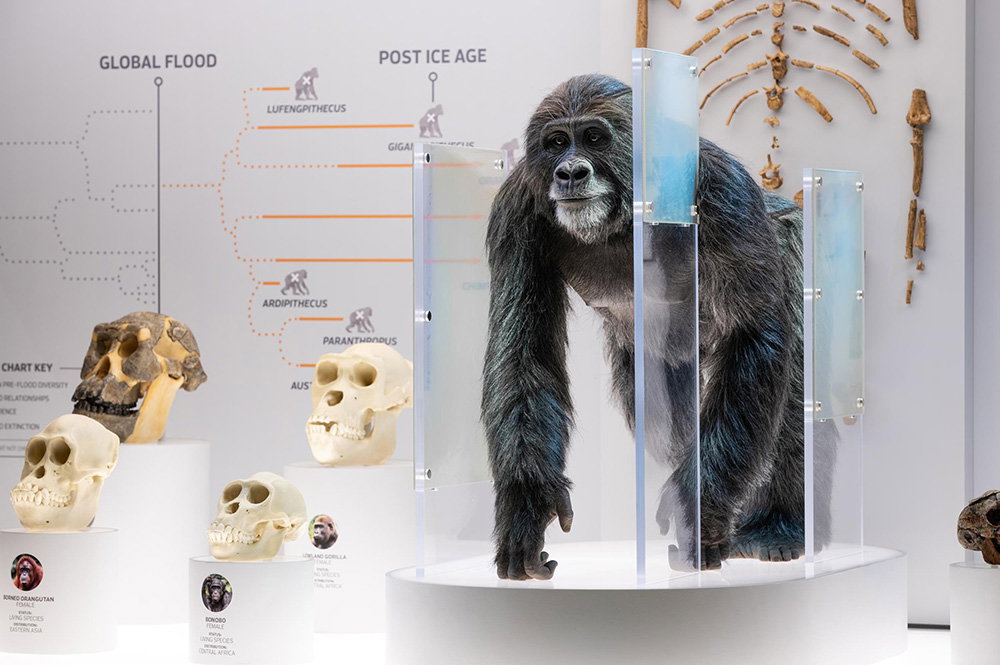
From a biblical creationist perspective, her kind is regarded as completely unrelated to people—the two having existed as separate kinds since the beginning. Though australopithecines have some distinctive traits, they most closely resemble the great apes, such as gorillas, chimpanzees, and orangutans. Thus, Lucy was a member of an ape kind instead of a human relative.
Art and Perspective
The head cast image below is from the same mold as our Lucy sculpture in our Starting Points exhibit. It represents what Lucy’s head might have looked like with only flesh. Artistic decisions can strongly influence how we view Lucy. Was she more humanlike or more apelike?
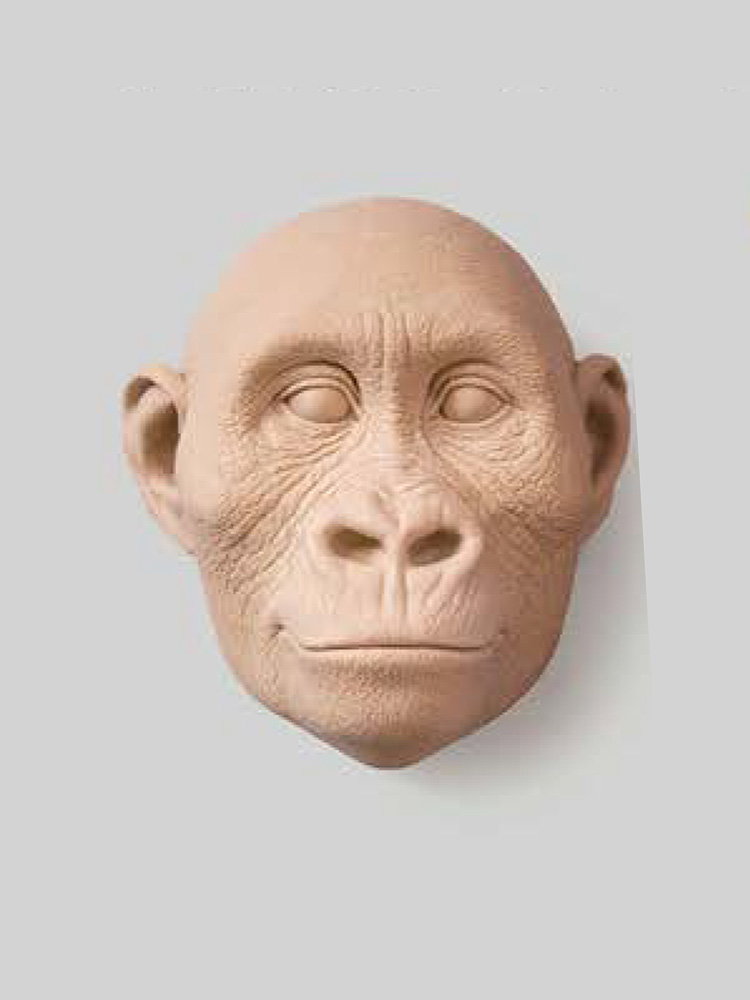
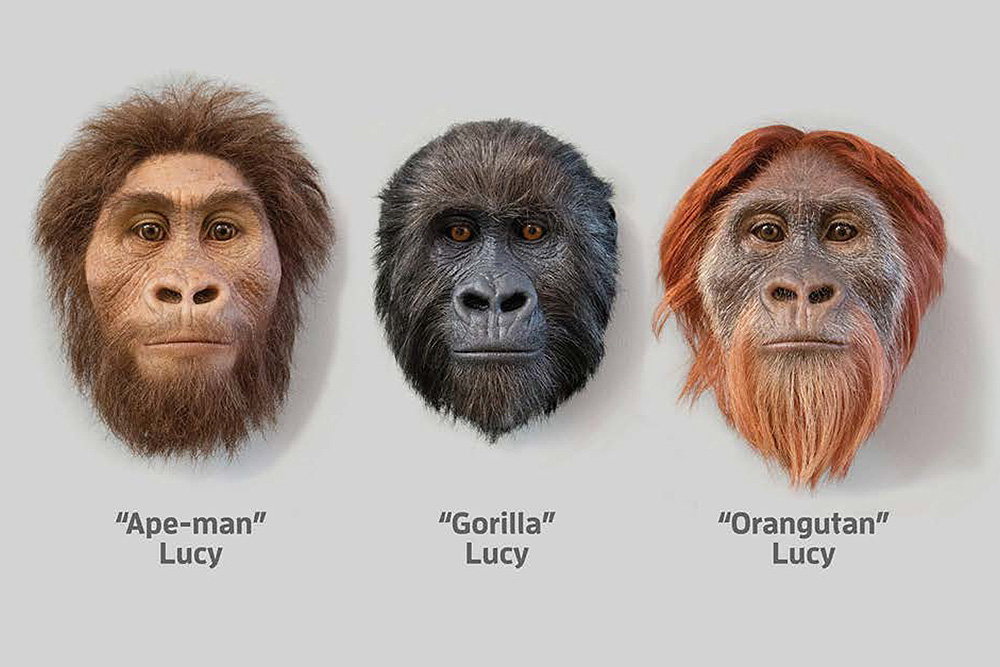
Below are three examples based on different art directions.
The Power of Perspective
Art is communication. Even when words are absent, it has a great capacity to convey meaning. When you look at a piece of art, remember that it speaks for the artist who crafted it to tell a story.
Consider the above depictions of australopithecine heads, cast from the same mold as the Lucy figure. Despite looking very different from one another, their sculpted details are identical. Only arbitrary details set them apart—things like hair, eye, and skin colors, as well as hair length and coverage.
Whether filling in missing bits of skull, surveying a bony surface for muscle attachment points, or choosing skin tones based on specimen location, degrees of assumption attend every stage of reconstruction. Ironically, the more superficial elements—those that represent the biggest unknowns—are often the most effective at conveying a broader narrative.
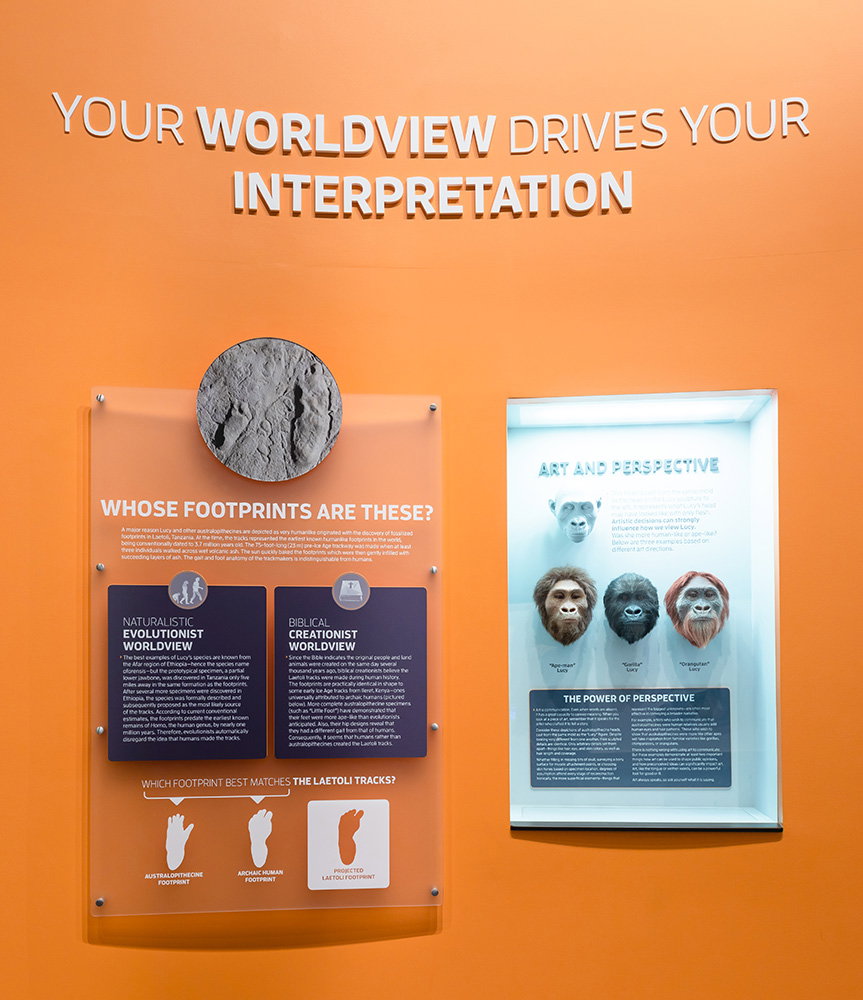
For example, artists who wish to communicate that australopithecines were human relatives usually add human eyes and hair patterns. Those who wish to show that australopithecines were more like other apes will take inspiration from familiar varieties like gorillas, chimpanzees, or orangutans.
There is nothing wrong with using art to communicate. But these examples demonstrate at least two important things: how art can be used to shape public opinions, and how preconceived ideas can significantly impact art. Art, like the tongue or written words, can be a powerful tool for good or ill.
Art always speaks, so ask yourself what it is saying.
Start planning your visit to the Creation Museum today, and be sure to learn more about Lucy in our Starting Points exhibit.
Prepare to Believe




Creation Museum Location
place
2800 Bullittsburg Church Rd.
Petersburg, KY 41080 (see directions)
Seven miles west of the Cincinnati Airport
An attraction of Answers in Genesis
2026 Answers in Genesis. All rights reserved. | Privacy Policy | Content Policy | Attraction Rules